History of DJ Equipment
DJ is an abbreviation of Disk Jockey. A disk jockey selects, plays and announces records at a live event or broadcast. Turntables or record players are used in DJing or turntablism. They were invented in 1877 and were called a phonograph ; they have been modified over the years and things such as sound quality and product quality were greatly increased. In the late 20th century they had developed into what we know as a record player or turntable.
DJing equipment has matured over the years and the way in which the DJ's have adapted and developed their technique around the change in technology is quite incredible. Old Djs have moved with the times to be able to create new sounds and mixes that were never before possible. Due to the change and development in technology, DJing equipment has changed hugely the way old Disk Jockeys collaborate their old style with new and popular techniques. Recent DJs are inspired to invent new and improved techniques to mix beats and tracks together with the purpose of impressing an audience and making a crowd dance. I think that the intention and purpose behind DJing hasn't really changed. They are still trying to get a crowd going but because of the development in technology they use modern ways to achieve this as well as sustaining the old methods. Factors such as sound quality, frequencies and frequency manipulation were unavailable when DJing first came about. These factors were never even considered, it wasn't possible to have any kind of influence on these things with the original turntable set ups.
DJing was originally performed in small clubs where just one turntable was used. An event or broadcast would consist of a DJ picking a record, playing it in full and when the track had ended he would swap over the record, while talking to the audience to announce the next song. This was later developed on by James Savile, the first man ever to use two turntables which enabled him to move from one track immediately into another without having to bore the audience after every song with chatter and introductions. This way the listeners could be nicely surprised by the sound of a record rather than the DJ introducing it. This would also result in a crown that would never have to stop dancing for anything. It would take away the silence between songs that would mean people had nothing to dance too. From this point the way DJing developed was heavily influenced by having two turntables and mixing two songs together.
The typical DJ set up would consist of two turntables and a mixer set up to a pair of speakers. DJs would take two records and mix between the songs using the mixers cross fader which allowed you to play the record on the other turntable or deck. If it was all the way to the left it would play the left deck and all the way to the right, the right deck. If it was in the middle it would play both together.
When the vinyl record was placed on the platter of the turntable you would then have to press start to get it spinning. You would then place the needle attached to the tone arm on the outer groove of the record and this would play a sound and the type of sound depended on the different grooves that were engraved into the vinyl disk. This differed from record to record. Your mixer was there predominantly to control the two decks and which one you wanted to listen to. It would also have volume faders for each deck enabling you to have control for each.
From this set up we had DJ's such as 'Grand Wizard Theodore' who was the first person ever to use the method of DJing involving the rocking forward and back of the record with his hand, now known as scratching. This technique was totally original and the sounds that were produced had never been heard before. After a few months other jockeys began to developed the scratching technique in their own way and would start to mix together drum breaks with very vocal songs and just quickly skip in and out of the vocal song creating some very interesting sounds using the cross fader and volume faders. One of the problems with scratching was the records themselves would be scratched and would jump when used again. This would mean that the DJ would have to buy several of the same record. As CDJ's and digital software such as Traktor were introduced, the famous scratching sound could still be recreated on these products as a digital sound and did not have the problem ruining the device but the original warm tones of a vinyl were missing. The evolution of equipment to CDJ's and digital software can't be improved on the first scratching sounds from a vinyl because it is a mechanical motion that creates the scratch sound, a need scratching back and forth in the grooves of a record.
DJ's such as Bambaataa and DJ Jazzy Jay used their own family records to practise scratching. They would also get together with other DJ's and experiment with records making Hip-Hop. In the original Hip-Hop clubs the DJ was used to get people dancing. This was achieved by playing the right music usually the part of a song called the break. A DJ called 'Kool Herc' would take funk records and find the break which was the part of the song that would get people dancing and he found ways to play this small section of a song for longer which meant the audience would be able to dance for longer. What Kool Herc would do is take two records that were exactly the same and find the break. He would then play the break of one then when that ended he would immediately play the same on the other record. He would use the cross fader to blend each song into the next and this would keep the groove going for longer. This was the beginnings of looping. This was a great way to get the audience dancing because he would play lots of the part of a song they loved to hear.
With the modern equipment such as Traktor and CDJ's, the idea and purpose of the DJ is the same although because of the new equipment new features have been added which have enabled DJ's to practise new techniques of making the audience dance. For example the CDJ's and digital software forms of DJ have EQ feature which allow a DJ to have control over the high, mid and low frequencies and this helps to create a certain vibe in a club or venue. By bringing in a new song with lots of bass which can be enhanced or boosted with EQ this is what fills a venue and really bring the life to the party. Some DJ's will use the technique of immediately taking the bass away to create tension. If a DJ is playing a 3 hour set they will almost immediately do this after the crowd has gone wild over a track because other wise they would tire the audience out too fast. By taking the bass out this creates tension and the crowd will get excited and when the bass drops with a new song the crowd will go crazy and everyone will be fist pumping until the nights end. Many DJ's use the evolution in equipment to build a style which they maintain and people start to like. A DJ who uses this style most of the time of Maya Jane Coles and very well known house DJ and she has used EQ to her advantage and created her own style of DJing and techniques. As seen in this video Mia Jane Coles is using the EQ to control the frequencies on each song to create moods and impact when she wants the crown to go nuts! When she takes away the bass it builds tention and excitement for what is about to happen and when she drops a new track she boost the bass and this is what give the great reaction from the crowd.
Most Hip-Hop DJs would never use the microphone as they would normally have an Master of Ceremonies (M.C). A lot of DJ's would hate having an M.C as it would take away from their show as a DJ. As DJ equipment progressed over the years the microphone was seen less and less in performances and these days it is almost never used. Some Hip-Hop DJs loved using the mic and felt it was a great was to interact with the audience but DJs like Grand Wizard Theodore never used the mic unless it was to say an important messages to an audience member never for performance purposes. Now the the equipment has advanced DJ don't need the mic to get the crowd going as there are feature on the equipment and techniques that mean the mic is less needed.
Although a man named 'David Rodigan' was very into using the mic. His performance was heavily based around talking to the crowd to get them going before he would play a song. He would also play some humorous songs and this was his style of DJing. He uses records to play his music and uses custom mixed songs that were personalised to make his performance more exciting and interesting. The custom cut records were very expensive and time consuming to make. Later with CD's it is very easy to burn a CD mix that you have and it has made this type of DJing method so much easier and DJs can make a new mix and on the same day burn a new CD and play it the same night at a club. A step further from this is the digital file. DJs now can put together a mix on there computer and with out even leaving the computer he can play that mix through Traktor as this software runs off files on your computer rather than physical copies.
Here he is in 1997 at battle. He is using vinyl decks as this was the best available although CD's were around people didn't generally have a huge music collection made up of CD's at this point so vinyl was the best what to play his music. Also there were no means of DJing with CD's in 1997. He is also using a mixer to put the link the two turntables to he can mix in his songs.
Behind him is a large crate of vinyl this is what he would have to carry around with him to every show, if not more and some just being copies of records he already has.
He is also using his microphone an awful lot which was quite uncommon to see a DJ do but his style was to use the microphone and entertain the crowd by talking to them. He is getting them ready for the next song. If you compare him to Mia Jane Coles she doesn't use the microphone at all yet she is still a fantastic DJ. Style in DJing is very important as if everyone was the same it would just be boring. he is also playing come comical songs which can al so get the crowd going.
13 years later he has moved with the times. Below he is using CDJ's which are your turntable equivalent for CD's. By this time CD's have peaked and vinyl is almost lost. People generally are buying CD's if not downloading music on the internet. David Rodigan can still be seen to use the microphone. His technique hasn't changed although his equipment has just moved with the times and he is using more up to date equipment which make things easier to operate. Rodigans way of performing still has the crowd going crazy but instead of using the EQ like Mia Jane Coles he plays a long song then talks to the crowd getting them excited! They are both very different techniques to DJing but both have proven very successful.
DJing with vinyl was heavily experimented with using lots of different techniques to impress an audience or other DJ's. This would include scratching and body tricks. There were many good points about using vinyl and DJs would spend hours and hours perfecting techniques to be the best. Vinyl is great because it has a particular sound that only vinyl and the feel of a real record for some people beats any kind of digital format or DJing. The sound quality of a vinyl for some people just has a very distinct sound of a physical disk turning under a needle. The warm tones of a record is one of the main reason why some people still play their old records as well as the pure joy of the music. The sound of the disk can't be replicated by any sort of digital format to have that real authentic sound. This isn't the only reason why many DJ's choose vinyl.
The simple idea of having a physical record that you OWNED was very heartwarming to some people especially if it was your favorite artist. Having your own copy of an album that you have bought from a store is so much more satisfying than clicking the 'buy now' button on iTunes then typing in your 'Apple ID' and having a physical collection of LPs, EP's and Singles even if it takes up the whole garage.
Another reason why vinyl is so great is having quality music and the process and lengths that people went through to have the best and latest music. people these days can accumulate tens of thousands of tracks on 1 laptop and will have any song that anyone wants hear at the click of a button but the beauty of vinyl was all the best music was very hard to get hold of and people would spend hours even days hunting down a copy of a new record or one that they really wanted to play and this is why vinyl was so special. The quality of music was so high because people spent so long getting hold of it and this is why every DJ was a lot different to another back then compared to now. The excitement of hearing a tune you had very heard before played by a DJ in a club was much more exciting than a DJ who has any track and the whole set is just music you have already heard. Because the DJ's had fewer tracks they spent more time and money hunting the best record rather than sitting at home buying 'NOW108' that has every popular song from the last 4 months on it ready to play until a new song comes out. The thought and effort that went into getting a a song was so high and this is why the DJ's appreciated the music more when they played. This also gave each DJ more time to practise each song and mixing a song was so perfect and a lot of thought would have gone into playing each song.
When buying music as vinyl the only way was to go to a store purchase the record. This meant communicating with the people in the store and making connections. Everyone in a music store would talk your language and this was a great way to get your hands on early releases of records and play hen at your shows. This is a great feature to vinyl because it meant you had to go to record shops and these were the kind of places that you would find the people who make the music. Now when you just buy online you never get your name out and its harder to speak to shops who sell music especially independant shops who might agree to selling your music and getting it out to new ears.
Lastly back in the day vinyls were quite valuable many were limited addition and eventually production of a particular vinyl would be no more. This made having good music more important because DJs knew that it wasn't going to be available forever. These days people have an endless supply of downloadable music and almost any track can be found online. Although CDs can sometimes be hard to get hold of especially if its an older record. This is a good thing and a bad thing about vinyl as it does make DJs significant and makes them different.
The reliability of vinyl is high although in terms of vinyl can vary it all depends on what it's used for. DJs who scratch do tend to destroy many records as well as the needles. The turntables are very reliable and DJs will keep the same turntables for years. Many record players and turntables are till around now in great condition that were manufactured in the later 60s although when a record gets scratched . The sound quality of a vinyl record is said to be nicer than any kind of digital system and the tones are so rich. Creative possibilities are almost endless with vinyl as you have a 100% hands on experience with the records and you are completely in control of what goes on. All the techniques have been discovered in DJing using vinyl and this is what makes is so great. Everything is manual which gives you more control over whats happening and make it sound your own. Although new systems have come into play to make this easier it is still very much loved and used because if its sound and originality because if it was all about the amount of music you can carry no one would ever use vinyl.
The cost of turntables and a mixer like any product can vary with quality. For a standard two turntable and mixer setup you could pay about £1000.00 give or take but again its the vinyl copies that are going to cost a lot because these days they have quite a high demand for some of the original and authentic vinyls.
CDJs are very highly used in the music industry at the moment. It's almost a compromise between completely digital and vinyl. People do have a lot of CDs these days especially people in their late 20s and 30s because this was the way to buy music when they were growing up. Vinyl was slipping away and digital downloads were not about. CDs were the thing. CDJs are a system for playing CDs and having the traditional DJ turntables to have an hands on approach.
CDJs are really good because they include all the features you want from a vinyl and almost all from digital downloads.
Good things are you get to have a physical copy of your music and it takes up much much much less from that vinyl once did. CDs could be stored in wallets without cases to save space and more could be carried around easier.
Another good thing was that although the sound quality to some people wasn't as good it brought about new ways of DJing and performing live with features such as the waveform displayed on the screen of the device.
Price for CDJs doesn't really compare to vinyl because it can be very expensive and can be thought of as the most expensive out of all 3 systems. Turntables can cost up to and around £1500 each and mixers can cost up to and around £2000 each so you could be spending about £4000 + by DJing this way. Compared to Traktor you dont have to buy a computer which is where most of the money in computer DJing goes as well as the music which is the same for all three types of DJing. Music on CD would cost around £7 to £12 for an album and maybe £2 or £3 for a single.
These are very reliable systems and they take a lot to scratch a CD where as on vinyl it would only take a small bump and the jump and the record would have forever lasting jump which would mean you had to get another copy. The sound quality of CDJs is very high depending on what format the file is thats on them. A high quality mp3 would have a really warm crisp sound. People chose this way of working because it suited so many of their needs that I was just a good compromise between vinyl and complete digital. The creative possibilities of CDJs did allow DJs to bypass some process that vinyl jockeys would have had to use. Such as each song has its own disk. With CDs being digital would can put most of the songs you want to use to DJ with onto two matching disks you can play your whole set off 2 disks. This did help with amount of equipment.
The invention of digital has changed everything in the music industry. In regards to DJing it has all given some fantastic advantages. The main advantage from using digital files is you can have all your music on you at any time and in several places at once for back up. This is something you would never have been able to do with CD or Vinyl without having to buy two or more copies of everything. This is just such a convent way of DJing because there is an endless amount of music you can have on you at any time all inside a laptop and maybe an external hard-drive. DJing this way does mean you have to plan your sets and stay organised otherwise you could get yourself into a right pickle. The other great thing about this is it would be common for a vinyl DJ to forget a record and have to use other songs. This would be very frustrating for a vinyl DJ. Also with the use of digital you never have to spend hours searching for that single you bought when you were 10 that is somewhere in your parents house. With digital you can search for any track you have all within the same library right before your eyes.
The typical DJ set up would consist of two turntables and a mixer set up to a pair of speakers. DJs would take two records and mix between the songs using the mixers cross fader which allowed you to play the record on the other turntable or deck. If it was all the way to the left it would play the left deck and all the way to the right, the right deck. If it was in the middle it would play both together.
 |
| Turntable |
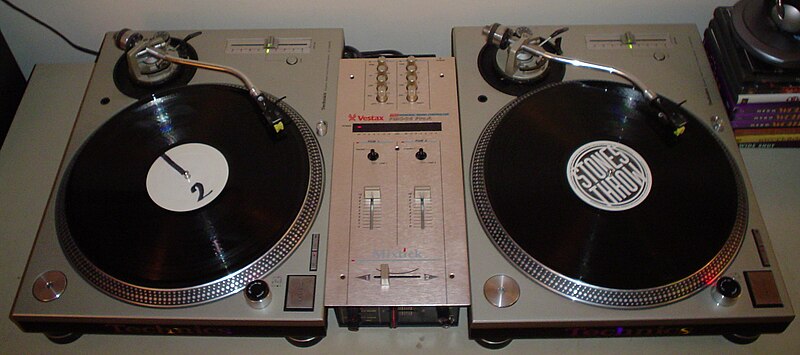 |
| A full turntable and mixer set up |
 |
| Mixer |
From this set up we had DJ's such as 'Grand Wizard Theodore' who was the first person ever to use the method of DJing involving the rocking forward and back of the record with his hand, now known as scratching. This technique was totally original and the sounds that were produced had never been heard before. After a few months other jockeys began to developed the scratching technique in their own way and would start to mix together drum breaks with very vocal songs and just quickly skip in and out of the vocal song creating some very interesting sounds using the cross fader and volume faders. One of the problems with scratching was the records themselves would be scratched and would jump when used again. This would mean that the DJ would have to buy several of the same record. As CDJ's and digital software such as Traktor were introduced, the famous scratching sound could still be recreated on these products as a digital sound and did not have the problem ruining the device but the original warm tones of a vinyl were missing. The evolution of equipment to CDJ's and digital software can't be improved on the first scratching sounds from a vinyl because it is a mechanical motion that creates the scratch sound, a need scratching back and forth in the grooves of a record.
DJ's such as Bambaataa and DJ Jazzy Jay used their own family records to practise scratching. They would also get together with other DJ's and experiment with records making Hip-Hop. In the original Hip-Hop clubs the DJ was used to get people dancing. This was achieved by playing the right music usually the part of a song called the break. A DJ called 'Kool Herc' would take funk records and find the break which was the part of the song that would get people dancing and he found ways to play this small section of a song for longer which meant the audience would be able to dance for longer. What Kool Herc would do is take two records that were exactly the same and find the break. He would then play the break of one then when that ended he would immediately play the same on the other record. He would use the cross fader to blend each song into the next and this would keep the groove going for longer. This was the beginnings of looping. This was a great way to get the audience dancing because he would play lots of the part of a song they loved to hear.
With the modern equipment such as Traktor and CDJ's, the idea and purpose of the DJ is the same although because of the new equipment new features have been added which have enabled DJ's to practise new techniques of making the audience dance. For example the CDJ's and digital software forms of DJ have EQ feature which allow a DJ to have control over the high, mid and low frequencies and this helps to create a certain vibe in a club or venue. By bringing in a new song with lots of bass which can be enhanced or boosted with EQ this is what fills a venue and really bring the life to the party. Some DJ's will use the technique of immediately taking the bass away to create tension. If a DJ is playing a 3 hour set they will almost immediately do this after the crowd has gone wild over a track because other wise they would tire the audience out too fast. By taking the bass out this creates tension and the crowd will get excited and when the bass drops with a new song the crowd will go crazy and everyone will be fist pumping until the nights end. Many DJ's use the evolution in equipment to build a style which they maintain and people start to like. A DJ who uses this style most of the time of Maya Jane Coles and very well known house DJ and she has used EQ to her advantage and created her own style of DJing and techniques. As seen in this video Mia Jane Coles is using the EQ to control the frequencies on each song to create moods and impact when she wants the crown to go nuts! When she takes away the bass it builds tention and excitement for what is about to happen and when she drops a new track she boost the bass and this is what give the great reaction from the crowd.
Most Hip-Hop DJs would never use the microphone as they would normally have an Master of Ceremonies (M.C). A lot of DJ's would hate having an M.C as it would take away from their show as a DJ. As DJ equipment progressed over the years the microphone was seen less and less in performances and these days it is almost never used. Some Hip-Hop DJs loved using the mic and felt it was a great was to interact with the audience but DJs like Grand Wizard Theodore never used the mic unless it was to say an important messages to an audience member never for performance purposes. Now the the equipment has advanced DJ don't need the mic to get the crowd going as there are feature on the equipment and techniques that mean the mic is less needed.
Although a man named 'David Rodigan' was very into using the mic. His performance was heavily based around talking to the crowd to get them going before he would play a song. He would also play some humorous songs and this was his style of DJing. He uses records to play his music and uses custom mixed songs that were personalised to make his performance more exciting and interesting. The custom cut records were very expensive and time consuming to make. Later with CD's it is very easy to burn a CD mix that you have and it has made this type of DJing method so much easier and DJs can make a new mix and on the same day burn a new CD and play it the same night at a club. A step further from this is the digital file. DJs now can put together a mix on there computer and with out even leaving the computer he can play that mix through Traktor as this software runs off files on your computer rather than physical copies.
Here he is in 1997 at battle. He is using vinyl decks as this was the best available although CD's were around people didn't generally have a huge music collection made up of CD's at this point so vinyl was the best what to play his music. Also there were no means of DJing with CD's in 1997. He is also using a mixer to put the link the two turntables to he can mix in his songs.
Behind him is a large crate of vinyl this is what he would have to carry around with him to every show, if not more and some just being copies of records he already has.
He is also using his microphone an awful lot which was quite uncommon to see a DJ do but his style was to use the microphone and entertain the crowd by talking to them. He is getting them ready for the next song. If you compare him to Mia Jane Coles she doesn't use the microphone at all yet she is still a fantastic DJ. Style in DJing is very important as if everyone was the same it would just be boring. he is also playing come comical songs which can al so get the crowd going.
13 years later he has moved with the times. Below he is using CDJ's which are your turntable equivalent for CD's. By this time CD's have peaked and vinyl is almost lost. People generally are buying CD's if not downloading music on the internet. David Rodigan can still be seen to use the microphone. His technique hasn't changed although his equipment has just moved with the times and he is using more up to date equipment which make things easier to operate. Rodigans way of performing still has the crowd going crazy but instead of using the EQ like Mia Jane Coles he plays a long song then talks to the crowd getting them excited! They are both very different techniques to DJing but both have proven very successful.
DJing with vinyl was heavily experimented with using lots of different techniques to impress an audience or other DJ's. This would include scratching and body tricks. There were many good points about using vinyl and DJs would spend hours and hours perfecting techniques to be the best. Vinyl is great because it has a particular sound that only vinyl and the feel of a real record for some people beats any kind of digital format or DJing. The sound quality of a vinyl for some people just has a very distinct sound of a physical disk turning under a needle. The warm tones of a record is one of the main reason why some people still play their old records as well as the pure joy of the music. The sound of the disk can't be replicated by any sort of digital format to have that real authentic sound. This isn't the only reason why many DJ's choose vinyl.
The simple idea of having a physical record that you OWNED was very heartwarming to some people especially if it was your favorite artist. Having your own copy of an album that you have bought from a store is so much more satisfying than clicking the 'buy now' button on iTunes then typing in your 'Apple ID' and having a physical collection of LPs, EP's and Singles even if it takes up the whole garage.
Another reason why vinyl is so great is having quality music and the process and lengths that people went through to have the best and latest music. people these days can accumulate tens of thousands of tracks on 1 laptop and will have any song that anyone wants hear at the click of a button but the beauty of vinyl was all the best music was very hard to get hold of and people would spend hours even days hunting down a copy of a new record or one that they really wanted to play and this is why vinyl was so special. The quality of music was so high because people spent so long getting hold of it and this is why every DJ was a lot different to another back then compared to now. The excitement of hearing a tune you had very heard before played by a DJ in a club was much more exciting than a DJ who has any track and the whole set is just music you have already heard. Because the DJ's had fewer tracks they spent more time and money hunting the best record rather than sitting at home buying 'NOW108' that has every popular song from the last 4 months on it ready to play until a new song comes out. The thought and effort that went into getting a a song was so high and this is why the DJ's appreciated the music more when they played. This also gave each DJ more time to practise each song and mixing a song was so perfect and a lot of thought would have gone into playing each song.
When buying music as vinyl the only way was to go to a store purchase the record. This meant communicating with the people in the store and making connections. Everyone in a music store would talk your language and this was a great way to get your hands on early releases of records and play hen at your shows. This is a great feature to vinyl because it meant you had to go to record shops and these were the kind of places that you would find the people who make the music. Now when you just buy online you never get your name out and its harder to speak to shops who sell music especially independant shops who might agree to selling your music and getting it out to new ears.
Lastly back in the day vinyls were quite valuable many were limited addition and eventually production of a particular vinyl would be no more. This made having good music more important because DJs knew that it wasn't going to be available forever. These days people have an endless supply of downloadable music and almost any track can be found online. Although CDs can sometimes be hard to get hold of especially if its an older record. This is a good thing and a bad thing about vinyl as it does make DJs significant and makes them different.
The reliability of vinyl is high although in terms of vinyl can vary it all depends on what it's used for. DJs who scratch do tend to destroy many records as well as the needles. The turntables are very reliable and DJs will keep the same turntables for years. Many record players and turntables are till around now in great condition that were manufactured in the later 60s although when a record gets scratched . The sound quality of a vinyl record is said to be nicer than any kind of digital system and the tones are so rich. Creative possibilities are almost endless with vinyl as you have a 100% hands on experience with the records and you are completely in control of what goes on. All the techniques have been discovered in DJing using vinyl and this is what makes is so great. Everything is manual which gives you more control over whats happening and make it sound your own. Although new systems have come into play to make this easier it is still very much loved and used because if its sound and originality because if it was all about the amount of music you can carry no one would ever use vinyl.
The cost of turntables and a mixer like any product can vary with quality. For a standard two turntable and mixer setup you could pay about £1000.00 give or take but again its the vinyl copies that are going to cost a lot because these days they have quite a high demand for some of the original and authentic vinyls.
CDJs are very highly used in the music industry at the moment. It's almost a compromise between completely digital and vinyl. People do have a lot of CDs these days especially people in their late 20s and 30s because this was the way to buy music when they were growing up. Vinyl was slipping away and digital downloads were not about. CDs were the thing. CDJs are a system for playing CDs and having the traditional DJ turntables to have an hands on approach.
CDJs are really good because they include all the features you want from a vinyl and almost all from digital downloads.
Good things are you get to have a physical copy of your music and it takes up much much much less from that vinyl once did. CDs could be stored in wallets without cases to save space and more could be carried around easier.
Another good thing was that although the sound quality to some people wasn't as good it brought about new ways of DJing and performing live with features such as the waveform displayed on the screen of the device.
Price for CDJs doesn't really compare to vinyl because it can be very expensive and can be thought of as the most expensive out of all 3 systems. Turntables can cost up to and around £1500 each and mixers can cost up to and around £2000 each so you could be spending about £4000 + by DJing this way. Compared to Traktor you dont have to buy a computer which is where most of the money in computer DJing goes as well as the music which is the same for all three types of DJing. Music on CD would cost around £7 to £12 for an album and maybe £2 or £3 for a single.
These are very reliable systems and they take a lot to scratch a CD where as on vinyl it would only take a small bump and the jump and the record would have forever lasting jump which would mean you had to get another copy. The sound quality of CDJs is very high depending on what format the file is thats on them. A high quality mp3 would have a really warm crisp sound. People chose this way of working because it suited so many of their needs that I was just a good compromise between vinyl and complete digital. The creative possibilities of CDJs did allow DJs to bypass some process that vinyl jockeys would have had to use. Such as each song has its own disk. With CDs being digital would can put most of the songs you want to use to DJ with onto two matching disks you can play your whole set off 2 disks. This did help with amount of equipment.
 |
| Top of the range CDJs |
As well as custom songs being very easy to produce in digital format it also means that if you are travelling somewhere you don't have to keep all your precious records in the hand luggage when ever you were to fly anywhere because they are to important to loose. With digital this is never a problem.
When records could only be found at record stores a lot of times limited amount of copies where available and there was a big competition to get records on pre-release and have them before anyone else did. This way you could play more up to date music and be a more popular DJ. This would include phoning record companies and convincing them to hold back copies before they have been released. There were a lot of dodgy deal going on but with digital this doesn't happen in the same way people can get music from hundreds of different on-line places and some people are just lucky if they can get a track earlier but there isn't backstreet black market deals happening with digital music.
Another good thing about digital is remixing. This can all be done with just the one copy. Before DJs would have to buy 2 records and have effects on one and mix the two together to create different mixes and loops.
The age of digital has changed the way DJ work and perform. This has made everything a lot quicker and less time consuming. Also the amount of less gear involved has drop enormously. You can turn up to any venue around the world with everything you need in one hand. This is another reason why the digital age has changed the way DJs can work and the scale in which they can work. With digital software for DJing like Traktor you can perform everything from your laptop and the USB decks that are compatible with Traktor. This is all you need to perform.
The sound quality of digital is very very good but in the end it's down to personal preference and some people just prefer the digital sound to a vinyl and it works the other way as well. Both forms are very good quality but with digital your copy of a song will never get broken or scratched and it will never jump. The reliability of a digital is very good although if you have all your music in only one place you run the risk of loosing everything. This can be avoided by having several copies across hard-drives and internet backups.
The prices of digital equipment is fairly expensive as you have to have a computer (usually a laptop) which can vary in prices between £500-£2500, if you are using Traktor then the digital decks for this is about £500 with software but where you can really spend all your money is on the music and this is an unlimited amount just like it would have been with vinyl and CD.
I think the digital age of DJing has some fantastic advantages to DJing and making the art of turntablism much easier to do. Although it has come at a cost you can always expect this if you are a DJ because if you are using vinyl, CDJ's or digital tracks you are always going to spend money on records. Although these days people can take any tune off the internet in a matter of minutes and use that in there sets the same day without paying a penny although it this is illegal.
People do say that using Traktor or a digital software method of DJing can be cheating as is does include features that are automatic where on a vinyl you would have to have done it manually and by ear which was a good test of your skill. This could be thought of a good thing but as the pioneer DJs had to practise their technique for hours and now you can do it with the touch of a button it can be thought of as cheating. An example of where this is used is syncing the two tracks together so you can match them up to make your transitions smoother. On digital software you can match the two tracks just by hitting 'sync' and they will have matched exactly. With vinyl you would have had to use your ear to hear whether the track was in time with the your first track and matching was all manual using the 'pitch fader'.
After considering all the types of DJing and what each set is good for and the pros and cons for each I think I would choose the CDJ's because I think that in this day and age this way suits me best. I love the idea of having the physical copy in my hands and playing this would be much more satisfying that playing something i've just clicked on with the mouse and with vinyl I would have to much music to carry which could be a good thing because it would make me be more selective.
I have a better understanding of how the digital world works and using CDJs just seems the obvious method. Another plus of being digital is could can now burn your music onto just a few CD's making your equipment load lighter. I love the could of CDs I grew up listening to them and I still only buy physical copies more or less and I think that using traktor is a good way if you are young and you want to DJ as the the cost is not too high if you already have a computer and I think it is a good way to get started. For me CDjs appeal to me the best and give me everything I would want to for DJing to my fullest potential.
Hedley Marks
____________________________________________________________________________
BIBLIOGRAPHY
Websites
Morse, P., 5 Reasons Why Digital DJing Beats Vinyl, Accessed on 25/11/13 , http://www.digitaldjtips.com/, [http://www.digitaldjtips.com/2010/03/five-reasons-why-digital-djing-beats-vinyl/]
Scratch Documentary: 2001
Director: Doug Pray
Palm Pictures
I think the digital age of DJing has some fantastic advantages to DJing and making the art of turntablism much easier to do. Although it has come at a cost you can always expect this if you are a DJ because if you are using vinyl, CDJ's or digital tracks you are always going to spend money on records. Although these days people can take any tune off the internet in a matter of minutes and use that in there sets the same day without paying a penny although it this is illegal.
People do say that using Traktor or a digital software method of DJing can be cheating as is does include features that are automatic where on a vinyl you would have to have done it manually and by ear which was a good test of your skill. This could be thought of a good thing but as the pioneer DJs had to practise their technique for hours and now you can do it with the touch of a button it can be thought of as cheating. An example of where this is used is syncing the two tracks together so you can match them up to make your transitions smoother. On digital software you can match the two tracks just by hitting 'sync' and they will have matched exactly. With vinyl you would have had to use your ear to hear whether the track was in time with the your first track and matching was all manual using the 'pitch fader'.
 |
| Traktor DJ Turntables |
After considering all the types of DJing and what each set is good for and the pros and cons for each I think I would choose the CDJ's because I think that in this day and age this way suits me best. I love the idea of having the physical copy in my hands and playing this would be much more satisfying that playing something i've just clicked on with the mouse and with vinyl I would have to much music to carry which could be a good thing because it would make me be more selective.
I have a better understanding of how the digital world works and using CDJs just seems the obvious method. Another plus of being digital is could can now burn your music onto just a few CD's making your equipment load lighter. I love the could of CDs I grew up listening to them and I still only buy physical copies more or less and I think that using traktor is a good way if you are young and you want to DJ as the the cost is not too high if you already have a computer and I think it is a good way to get started. For me CDjs appeal to me the best and give me everything I would want to for DJing to my fullest potential.
Hedley Marks
____________________________________________________________________________
BIBLIOGRAPHY
Websites
Morse, P., 5 Reasons Why Digital DJing Beats Vinyl, Accessed on 25/11/13 , http://www.digitaldjtips.com/, [http://www.digitaldjtips.com/2010/03/five-reasons-why-digital-djing-beats-vinyl/]
Junglist For Life, A Different Viewpoint: 5 Reasons Why Vinyl DJing Beats Digital, http://www.digitaldjtips.com/, http://www.digitaldjtips.com/2010/11/why-vinyl-djing-beats-digital/
DocumentariesScratch Documentary: 2001
Director: Doug Pray
Palm Pictures

No comments:
Post a Comment