Friday, 13 December 2013

Functions of the Keyboard


Functions of the Keyboard


Q1)
Grand pianos have three pedals. The left also called the 'Una Corda' this is the soft pedal and is used on a grand piano to soften the sound although the timbre and tone are effected by this pedal also. The way this works is when the pedal is pressed all the keys are shifted to the right moving the hammers across so where as before they would hit across all three strings the hammer will now only hit one of the three strings. This gives a lighter and softer sound. 

The middle or sostento pedal was the last pedal to be added. This pedal when played only sustains the strings that you have played simultaneously to pressing the pedal. This means that you are free to play the rest of the keys without them being affected.

The right or sustain pedal holds the notes across the whole piano until you release the pedal. When you play a note it would normally be dampened. This pedal lifts all the dampeners and lets all the strings ring together. The great advantage to this is that sympathetic resonance can occur. This is where the notes in the harmonic sequence of the note that is played are going to vibrate. As well as this having a string vibrating right next to another one is going to cause the strings close to it to resonate because the energy will transfer across to the adjacent strings. The sound board of the piano is there to predominately amplify the sound of the strings and its because of the sound board that the sympathetic resonance across the strings is so great and this is what puts the grand into grand piano along with its size.   

Q2) 
The grand piano and upright piano have quite a few differences the first one mainly being the size. A large concert grand can be about 9 feet long but an upright are specifically made to give the biggest sound but take up as little room as possible. The upright piano has a small sound board but its also positioned vertically where as in a grand the sound board is positioned horizontally making the entire piano much much bigger and louder.
Another difference is the middle pedal. On a grand piano this is the sostenuto pedal. The equivalent pedal on a upright piano does the same thing just it uses a different mechanism to do so. On a grand the sostenuto pedal sustain the notes that you play while pressing the pedal meaning you can be free to play other notes that will not be sustained. On an upright this softer sounds is created by a felt cloth coming down in front of all the keys meaning the hammers don't have a direct contact resulting in a softer sound. On an upright piano this pedal is called a practise pedal.

The left pedal on an upright moves hammers in a position closer to the strings.

Another difference between the grand and the upright is the lid and I feel that this has such a big effect of the overall sound that the piano produces. The lid on a grand piano is very large and cover the whole body including the strings and soundboard. A grand piano has 2 setting for the lid, either fully open or slightly open. This changes the tone of the piano completely and having this option can give the piano player some control over the tone he wants. On an upright the lid is very small, it can be opened but it doesn't have a huge effect on the sound of the piano. As the lid only opens a small amount from he top and doesn't open up all the sound from all the strings and sound board like the grand piano you are never going to get the tone like a grand piano gives with the lid open. This is a very big difference as the lid effect the sound of each piano as a whole and because of the uprights much smaller lid and configuration and positioning of the sound board and strings inside it will never give the true sound of a grand. 

Q3)
A MIDI is made up of samples that the manufacturer as produced and the quality and detail of these samples determines how good and realistic the midi sound is. The MIDI controllers have control over a few of the major parameter of a piano sound but some are just to complex to recreate. A MIDI controller can usually control the velocity of a note and the length of the note being held. It can also control sustain with the addition of a pedal. These features combined give a somewhat realistic sound of a grand piano but there are many elements missing.

Q4)


Tuesday, 3 December 2013

Area of the Industry | Chloe Herington


Areas of the Music Industry


I have been asked to give a special report on four key areas of the music industry. Record Companies, Artist Management, Music Publishing and Live Performance. I am going to talk about the good and bad points for all of these as well as what they do and how they work.

RECORD COMPANIES

a) A record company is an organisation that take on artists that they feel can be successful and hopefully make money. There are several different deals a record company can offer to an artist some bigger than other but it is just an investment that they believe will make them money back. Record companies will sometimes give you money in advance to make a record and then they will sell it for you. Record companies will market your record among other things just depends on the deal that an artist of offered. The point of a record company is to almost brand your artist name under a bigger company that has power and money and the means of getting your music made and then sold. Getting your music sold on a large scale of very hard without a record company and would cost more money that your average artist has when they start making music. The way the record companies make money are by selling your music and within the deal will be a percentage of how much they are going to take from the profit of the sales. within the deal they will provide you with the funds to make the record but it does depend on the deal.
Large record companies such as the majors Warner Bros, Sony and Universal do provide all services such as distribution and publishing but depending on the deal is how much they will invent in you. Good record companies will give you worthwhile deals but some can seem good at first but leave you worse off. One thing that record companies sometime control again depending on the company and the deal they will sometimes take ownership of the music. The three major companies will give you a huge advance on your record to spend on making a great record but then they will take control of how the material is released and they will own you and your music after the contract has been signed, whether or not you stick with the deal. This is some of the problems with signing to a major label if you are not going to me MASSIVE!
You can also get record deals with independent Record Companies such as Domino, XL and Brew. These companies are self funded and will not have as much power like the majors but give artist a more worthwhile deal.
you can also get subsidiary record companies that are almost in the middle and are partly independent but are overlooked by one of the majors. a good example would be Island Records, they are a subsidiary record company that are also owned and overlooked by Universal who have a say in everything that Island do. They will also have some right to your music usually. Personally I would much rather be offered a record deal from an independent record company because although they wont have the funds like a major you are given a bit more freedom and say over your music and more times than not you keep the right to your music. This can also lead to the label selling you onto someone bigger who wants to make you successful with more power. From what I have observed the independent companies like to support and push artists that have a passion about the music that they are making despite if it is going to a no1 hit and they care more about the music than the money. Obviously they do make money especially the big independent companies but that comes from having a good A&R department that choose good accomplished musicians that look like they can bring something new and exciting to the industry.

ARTIST MANAGEMENT

b) An artist manager is the body that works closely to the artist and keeps their career running smoothly and that they are where they need to be at the right times. This could include meetings, studio times, tour dates, time for personal life and photoshoots. The artists manager is very hands on and works more personally than the other workers in the industry that are linked to the artist. Artist management is very crucial part of the music industry for an artist as if you have a good manager it could be the difference between being successful and not. The reason an artist will get a manager is because they can't handle everything that is going by themselves and it is starting to affect them as a working artist. Maybe it's because they have had a few deals come in and they don't quite know what choices to make and if they agree they wont be able to pursue the way they currently are. If an artist is being approached by large companies who want to work with them and make the successful such as record companies, PR, distribution or publishing deals the artist may or may not know the best choices to make of they are allows as well as not having any time to deal with things properly because they need to be practising for a upcoming tour. A manage is great because once you go from handling everything yourself to having to do nothing you have much more time to rehearse, write music and more importantly play gigs.
Another thing the artist manager is the one who represents the artist on big decisions that the artist doesn't have time to deal with because they are too busy performing and being an artist.
Having a manager is all very good but they have to be good otherwise they will be not use to you and they won't make any money. The general agreement with management is they will take 15 or 20% of everything the artist makes which can be a lot or nothing at all. This is why its in the best interest of the manager to do everything he/she can to make the band money. A good manager will also know all the top people across the industry and this will help you become more successful. This is one way you can determine whether a manager is any good. You can also look at there history and find out how many bands they are currently working with as well because you might not want someone who is also managing two other bands and only has a 3rd of their time for you. You are also going to want use a manager who has already bought a band or artist to success already, one that has a good reputation for big tours and selling lots of music.
You do not want a manager that is untrustworthy and doesn't care where your career is heading. There has to be a lot of trust between an artist and manager because their whole career as an artist is in their hands as they will be making a lot of decisions for you.
There are a lot of consideration when getting a manager you might even think you need a manager when you can already handle things alone and this can loose you money but then you could also loose out on opportunities of you are trying to do everything yourself and you never have time to take the advantages of a manager. This could mean you save money but you also don't have any time for rehearsal or playing gigs.
I think if I was looking for a manager I would be interested in what a manager has done previously and where up the industry ladder they are and whether they are going to be useful. I think it would b important top make an estimate  and over look the number of hours a week you are spending doing the things a manager would do then see if it is really worthwhile. If they are going to be taking a fifth of everything you earn they need to be good and worthwhile. So paying someone £200 a month for doing something that you could do if you could be bothered is not a worthy investment. 

MUSIC PUBLISHING

Music publishing is almost the next step after a record company has released an artist's record. What a publisher does is makes a song marketable and then sells it. You see bands releasing songs as singles usually the most catchy one that the majority of the people are going to like, it is often the one that the album is named after. Music publishers sell the artist's songs to television companies and get it played on tv and anywhere they can, even featured in films. You manager will be heavily involved with the publisher as they will be involved with contract. Different companies will offer different publishing deals for so many years etc. The publishers job can also be to work with a record company and deciding what songs will be most popular, which ones should be played when and where and matching it with the release of singles and album releases. It is a form of advertising where they will try to get as many people as possible to hear your music and then hopefully buy it. Way in which publishers will sell your music is through adverts, television getting it played on youtube as an advert and featuring in as many different places possible. The more the songs are sold in this way the more people will hear it and want to buy it. This then leads to people following you online, hearing about a new tour under the name of their favorite song or album and paying money to come see you live in a town near them and then hopefully buying a T-shirt as well.
Music publishing is such a huge part of the music industry and it can even be seen in forms such as telling radio editors how to edit a song for the radio that will play as much of the choruses and as little of the 'boring' bits of a song to make marketable on the radio and on TV.
Getting a publishing deal can be a very good thing and it can also push your career very far forward and resulting in lots of music sold and
Publishers are only interested in the music that will sell, this is the only way they make money. If they don't feel that your music won't sell enough copies to match the efforts that put in to get your music heard they are not going to give you a deal. Getting a publishing deal can be very hard work but very rewarding. This is why you need a good manager to use their contacts and good persuading skills to push their artist to success.


LIVE MUSIC

Live music is a very important part of the industry because you can be achieving the best in all the other areas, you could be signed to a massive record label, have the best manager in town and have publishers putting your music everywhere but if you are not playing live gigs you are never going to have any fans that will buy your music and you will never have a chance to play your songs to a real crowd. As well as being a part of the industry that can make a lot of money it is also a lot work for everyone involved. The importance of playing live is its something that needs to be regular. If you never play live your fans are going to think you are dead. Playing shows are a great way to personally talk to the people who like your music. Playing live gives you material to talk about on social networks, if you never play live shows you will have less to talk about to your fans online to keep them interested. If you haven't released an album for two years and you are supposed to be touring but you aren't playing shows people will wonder what you are doing. Shows make money. It is an opportunity to sell merchandise and sell your music to fans. This like limited edition posters or vinyl singles are great products to sell only at live gigs. This attracts people to spend money at your shows as well as paying for a ticket. Playing your music over the country is so important when it comes to expansion, you never know who might just walk into a venue and hear your music. The main reason why artists spend so much time playing gigs of anytime is to let people hear your music from places that might have never heard of you as well as the places that you are very popular to maintain a reputation. it is the job of your artist manager to book tours and depending on how good your manager is the bigger the shows they will get you onto. Another great way to get your name out especially to new crowds is to support larger bands this way you are exposing your music to new people and to the fans of other bands. This is commonly done by artist from the same record label and they will play together almost to help each other.
There are so many reasons to play live shows in as many places and as consistently as possible this is how you build fans and this is what record companies and publishers are going to be interested in and will choose someone who has played in many cities and build a fan base compared to someone who has almost no fans. This way they give themselves a bit of headroom while working with the band.
It is common for an artist to take breaks from touring and to separate their tours as you can brand a tour name under an album name or song name which can then go on t-shirts and any kind of merchandise. Separating tours also gives the artist time to work on new material and prepare new stages shows for different sized venues or countries.


All four of these parts to the music industry are just as important as each other. One leads to another and they all can all lead to success. It takes a lot of hard work to get to push all of these areas but you almost need all of them to some degree for your career to boom.
You will need a good manager predominantly to get the other three things working. You will need a record company to want to fund your record before you can play live shows and have any sort of publisher to sell your music. You can bypass this one and produce you record yourself and still play live shows and get a publishing deal without having a record label. Once you have your record you can start to get it published all over the world and build fans by playing live music. To prosper in the music industry you have to understand that all three of these are very important and you have to do as much work for all of them.

Hedley Marks

BIBLIOGRAPHY___________________________________________________________________

Web Pages
http://en.wikipedia.org/wiki/Record_label 3rd December, http://en.wikipedia.org/wiki/Main_Page, Record Labels

Tuesday, 26 November 2013

History Of DJ Equipment | Phil Robinson

History of DJ Equipment
  
DJ is an abbreviation of Disk Jockey. A disk jockey selects, plays and announces records at a live event or broadcast. Turntables or record players are used in DJing or turntablism. They were invented in 1877 and were called a phonograph ; they have been modified over the years and things such as sound quality and product quality were greatly increased. In the late 20th century they had developed into what we know as a record player or turntable.

DJing equipment has matured over the years and the way in which the DJ's have adapted and developed their technique around the change in technology is quite incredible. Old Djs have moved with the times to be able to create new sounds and mixes that were never before possible. Due to the change and development in technology, DJing equipment has changed hugely the way old Disk Jockeys collaborate their old style with new and popular techniques. Recent DJs are inspired to invent new and improved techniques to mix beats and tracks together with the purpose of impressing an audience and making a crowd dance. I think that the intention and purpose behind DJing hasn't really changed. They are still trying to get a crowd going but because of the development in technology they use modern ways to achieve this as well as sustaining the old methods. Factors such as sound quality, frequencies and frequency manipulation were unavailable when DJing first came about. These factors were never even considered, it wasn't possible to have any kind of influence on these things with the original turntable set ups.

 DJing was originally performed in small clubs where just one turntable was used. An event or broadcast would consist of a DJ picking a record, playing it in full and when the track had ended he would swap over the record, while talking to the audience to announce the next song. This was later developed on by James Savile, the first man ever to use two turntables which enabled him to move from one track immediately into another without having to bore the audience after every song with chatter and introductions. This way the listeners could be nicely surprised by the sound of a record rather than the DJ introducing it. This would also result in a crown that would never have to stop dancing for anything. It would take away the silence between songs that would mean people had nothing to dance too. From this point the way DJing developed was heavily influenced by having two turntables and mixing two songs together.

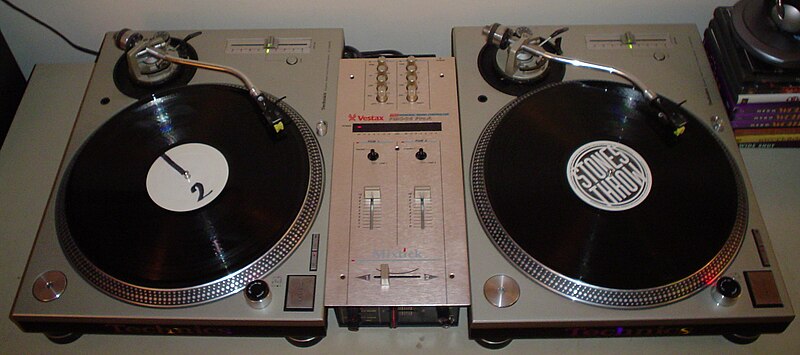
The typical DJ set up would consist of two turntables and a mixer set up to a pair of speakers. DJs would take two records and mix between the songs using the mixers cross fader which allowed you to play the record on the other turntable or deck. If it was all the way to the left it would play the left deck and all the way to the right, the right deck. If it was in the middle it would play both together.


Turntable
When the vinyl record was placed on the platter of the turntable you would then have to press start to get it spinning. You would then place the needle attached to the tone arm on the outer groove of the record and this would play a sound and the type of sound depended on the different grooves that were engraved into the vinyl disk. This differed from record to record. Your mixer was there predominantly to control the two decks and which one you wanted to listen to. It would also have volume faders for each deck enabling you to have control for each.
File:Turntables and mixer.jpg
A full turntable and mixer set up
Mixer


From this set up we had DJ's such as 'Grand Wizard Theodore' who was the first person ever to use the method of DJing involving the rocking forward and back of the record with his hand, now known as scratching. This technique was totally original and the sounds that were produced had never been heard before. After a few months other jockeys  began to developed the scratching technique in their own way and would start to mix together drum breaks with very vocal songs and just quickly skip in and out of the vocal song creating some very interesting sounds using the cross fader and volume faders. One of the problems with scratching was the records themselves would be scratched and would jump when used again. This would mean that the DJ would have to buy several of the same record. As CDJ's and digital software such as Traktor were introduced, the famous scratching sound could still be recreated on these products as a digital sound and did not have the problem ruining the device but the original warm tones of a vinyl were missing. The evolution of equipment to CDJ's and digital software can't be improved on the first scratching sounds from a vinyl because it is a mechanical motion that creates the scratch sound, a need scratching back and forth in the grooves of a record.


DJ's such as Bambaataa and DJ Jazzy Jay used their own family records to practise scratching. They would also get together with other DJ's and experiment with records making Hip-Hop. In the original Hip-Hop clubs the DJ was used to get people dancing. This was achieved by playing the right music usually the part of a song called the break. A DJ called 'Kool Herc' would take funk records and find the break which was the part of the song that would get people dancing and he found ways to play this small section of a song for longer which meant the audience would be able to dance for longer. What Kool Herc would do is take two records that were exactly the same and find the break. He would then play the break of one then when that ended he would immediately play the same on the other record. He would use the cross fader to blend each song into the next and this would keep the groove going for longer. This was the beginnings of looping. This was a great way to get the audience dancing because he would play lots of the part of a song they loved to hear.

With the modern equipment such as Traktor and CDJ's, the idea and purpose of the DJ is the same although because of the new equipment new features have been added which have enabled DJ's to practise new techniques of making the audience dance. For example the CDJ's and digital software forms of DJ have EQ feature which allow a DJ to have control over the high, mid and low frequencies and this helps to create a certain vibe in a club or venue. By bringing in a new song with lots of bass which can be enhanced or boosted with EQ this is what fills a venue and really bring the life to the party. Some DJ's will use the technique of immediately taking the bass away to create tension. If a DJ is playing a 3 hour set they will almost immediately do this after the crowd has gone wild over a track because other wise they would tire the audience out too fast. By taking the bass out this creates tension and the crowd will get excited and when the bass drops with a new song the crowd will go crazy and everyone will be fist pumping until the nights end. Many DJ's use the evolution in equipment to build a style which they maintain and people start to like. A DJ who uses this style most of the time of Maya Jane Coles and very well known house DJ and she has used EQ to her advantage and created her own style of DJing and techniques. As seen in this video Mia Jane Coles is using the EQ to control the frequencies on each song to create moods and impact when she wants the crown to go nuts! When she takes away the bass it builds tention and excitement for what is about to happen and when she drops a new track she boost the bass and this is what give the great reaction from the crowd.


Most Hip-Hop DJs would never use the microphone as they would normally have an Master of Ceremonies (M.C). A lot of DJ's would hate having an M.C as it would take away from their show as a DJ. As DJ equipment progressed over the years the microphone was seen less and less in performances and these days it is almost never used. Some Hip-Hop DJs loved using the mic and felt it was a great was to interact with the audience but DJs like Grand Wizard Theodore never used the mic unless it was to say an important messages to an audience member never for performance purposes. Now the the equipment has advanced DJ don't need the mic to get the crowd going as there are feature on the equipment and techniques that mean the mic is less needed.

Although a man named 'David Rodigan' was very into using the mic. His performance was heavily based around talking to the crowd to get them going before he would play a song. He would also play some humorous songs and this was his style of DJing. He uses records to play his music and uses custom mixed songs that were personalised to make his performance more exciting and interesting. The custom cut records were very expensive and time consuming to make. Later with CD's it is very easy to burn a CD mix that you have and it has made this type of DJing method so much easier and DJs can make a new mix and on the same day burn a new CD and play it the same night at a club. A step further from this is the digital file. DJs now can put together a mix on there computer and with out even leaving the computer he can play that mix through Traktor as this software runs off files on your computer rather than physical copies.

 Here he is in 1997 at battle. He is using vinyl decks as this was the best available although CD's were around people didn't generally have a huge music collection made up of CD's at this point so vinyl was the best what to play his music. Also there were no means of DJing with CD's in 1997. He is also using a mixer to put the link the two turntables to he can mix in his songs.
Behind him is a large crate of vinyl this is what he would have to carry around with him to every show, if not more and some just being copies of records he already has.

He is also using his microphone an awful lot which was quite uncommon to see a DJ do but his style was to use the microphone and entertain the crowd by talking to them. He is getting them ready for the next song. If you compare him to Mia Jane Coles she doesn't use the microphone at all yet she is still a fantastic DJ. Style in DJing is very important as if everyone was the same it would just be boring. he is also playing come comical songs which can al so get the crowd going.


13 years later he has moved with the times. Below he is using CDJ's which are your turntable equivalent for CD's. By this time CD's have peaked and vinyl is almost lost. People generally are buying CD's if not downloading music on the internet. David Rodigan can still be seen to use the microphone. His technique hasn't changed although his equipment has just moved with the times and he is using more up to date equipment which make things easier to operate. Rodigans way of performing still has the crowd going crazy but instead of using the EQ like Mia Jane Coles he plays a long song then talks to the crowd getting them excited! They are both very different techniques to DJing but both have proven very successful.


DJing with vinyl was heavily experimented with using lots of different techniques to impress an audience or other DJ's. This would include scratching and body tricks. There were many good points about using vinyl and DJs would spend hours and hours perfecting techniques to be the best. Vinyl is great because it has a particular sound that only vinyl and the feel of a real record for some people beats any kind of digital format or DJing. The sound quality of a vinyl for some people just has a very distinct sound of a physical disk turning under a needle. The warm tones of a record is one of the main reason why some people still play their old records as well as the pure joy of the music. The sound of the disk can't be replicated by any sort of digital format to have that real authentic sound. This isn't the only reason why many DJ's choose vinyl.
The simple idea of having a physical record that you OWNED was very heartwarming to some people especially if it was your favorite artist. Having your own copy of an album that you have bought from a store is so much more satisfying than clicking the 'buy now' button on iTunes then typing in your 'Apple ID' and having a physical collection of LPs, EP's and Singles even if it takes up the whole garage.
Another reason why vinyl is so great is having quality music and the process and lengths that people went through to have the best and latest music. people these days can accumulate tens of thousands of tracks on 1 laptop and will have any song that anyone wants hear at the click of a button but the beauty of vinyl was all the best music was very hard to get hold of and people would spend hours even days hunting down a copy of a new record or one that they really wanted to play and this is why vinyl was so special. The quality of music was so high because people spent so long getting hold of it and this is why every DJ was a lot different to another back then compared to now. The excitement of hearing a tune you had very heard before played by a DJ in a club was much more exciting than a DJ who has any track and the whole set is just music you have already heard. Because the DJ's had fewer tracks they spent more time and money hunting the best record rather than sitting at home buying 'NOW108' that has every popular song from the last 4 months on it ready to play until a new song comes out. The thought and effort that went into getting a a song was so high and this is why the DJ's appreciated the music more when they played. This also gave each DJ more time to practise each song and mixing a song was so perfect and a lot of thought would have gone into playing each song.
When buying music as vinyl the only way was to go to a store purchase the record. This meant communicating with the people in the store and making connections. Everyone in a music store would talk your language and this was a great way to get your hands on early releases of records and play hen at your shows. This is a great feature to vinyl because it meant you had to go to record shops and these were the kind of places that you would find the people who make the music. Now when you just buy online you never get your name out and its harder to speak to shops who sell music especially independant shops who might agree to selling your music and getting it out to new ears.
Lastly back in the day vinyls were quite valuable many were limited addition and eventually production of a particular vinyl would be no more. This made having good music more important because DJs knew that it wasn't going to be available forever. These days people have an endless supply of downloadable music and almost any track can be found online. Although CDs can sometimes be hard to get hold of especially if its an older record. This is a good thing and a bad thing about vinyl as it does make DJs significant and makes them different.
The reliability of vinyl is high although in terms of vinyl can vary it all depends on what it's used for. DJs who scratch do tend to destroy many records as well as the needles. The turntables are very reliable and DJs will keep the same turntables for years. Many record players and turntables are till around now in great condition that were manufactured in the later 60s although when a record gets scratched . The sound quality of a vinyl record is said to be nicer than any kind of digital system and the tones are so rich. Creative possibilities are almost endless with vinyl as you have a 100% hands on experience with the records and you are completely in control of what goes on. All the techniques have been discovered in DJing using vinyl and this is what makes is so great. Everything is manual which gives you more control over whats happening and make it sound your own. Although new systems have come into play to make this easier it is still very much loved and used because if its sound and originality because if it was all about the amount of music you can carry no one would ever use vinyl.
The cost of turntables and a mixer like any product can vary with quality. For a standard two turntable and mixer setup you could pay about £1000.00 give or take but again its the vinyl copies that are going to cost a lot because these days they have quite a high demand for some of the original and authentic vinyls.

CDJs are very highly used in the music industry at the moment. It's almost a compromise between completely digital and vinyl. People do have a lot of CDs these days especially people in their late 20s and 30s because this was the way to buy music when they were growing up. Vinyl was slipping away and digital downloads were not about. CDs were the thing. CDJs are a system for playing CDs and having the traditional DJ turntables to have an hands on approach.
CDJs are really good because they include all the features you want from a vinyl and almost all from digital downloads.
Good things are you get to have a physical copy of your music and it takes up much much much less from that vinyl once did. CDs could be stored in wallets without cases to save space and more could be carried around easier.
Another good thing was that although the sound quality to some people wasn't as good it brought about new ways of DJing and  performing live with features such as the waveform displayed on the screen of the device.

Price for CDJs doesn't really compare to vinyl because it can be very expensive and can be thought of as the most expensive out of all 3 systems. Turntables can cost up to and around £1500 each and mixers can cost up to and around £2000 each so you could be spending about £4000 + by DJing this way. Compared to Traktor you dont have to buy a computer which is where most of the money in computer DJing goes as well as the music which is the same for all three types of DJing. Music on CD would cost around £7 to £12 for an album and maybe £2 or £3 for a single.
These are very reliable systems and they take a lot to scratch a CD where as on vinyl it would only take a small bump and the jump and the record would have forever lasting jump which would mean you had to get another copy. The sound quality of CDJs is very high depending on what format the file is thats on them. A high quality mp3 would have a really warm crisp sound. People chose this way of working because it suited so many of their needs that I was just a good compromise between vinyl and complete digital. The creative possibilities of CDJs did allow DJs to bypass some process that vinyl jockeys would have had to use. Such as each song has its own disk. With CDs being digital would can put most of the songs you want to use to DJ with onto two matching disks you can play your whole set off 2 disks. This did help with amount of equipment.
Top of the range CDJs
The invention of digital has changed everything in the music industry. In regards to DJing it has all given some fantastic advantages. The main advantage from using digital files is you can have all your music on you at any time and in several places at once for back up. This is something you would never have been able to do with CD or Vinyl without having to buy two or more copies of everything. This is just such a convent way of DJing because there is an endless amount of music you can have on you at any time all inside a laptop and maybe an external hard-drive. DJing this way does mean you have to plan your sets and stay organised otherwise you could get yourself into a right pickle. The other great thing about this is it would be common for a vinyl DJ to forget a record and have to use other songs. This would be very frustrating for a vinyl DJ. Also with the use of digital you never have to spend hours searching for that single you bought when you were 10 that is somewhere in your parents house. With digital you can search for any track you have all within the same library right before your eyes.
As well as custom songs being very easy to produce in digital format it also means that if you are travelling somewhere you don't have to keep all your precious records in the hand luggage when ever you were to fly anywhere because they are to important to loose. With digital this is never a problem.
When records could only be found at record stores a lot of times limited amount of copies where available and there was a big competition to get records on pre-release and have them before anyone else did. This way you could play more up to date music and be a more popular DJ. This would include phoning record companies and convincing them to hold back copies before they have been released. There were a lot of dodgy deal going on but with digital this doesn't happen in the same way people can get music from hundreds of different on-line places and some people are just lucky if they can get a track earlier but there isn't backstreet black market deals happening with digital music.
Another good thing about digital is remixing. This can all be done with just the one copy. Before DJs would have to buy 2 records and have effects on one and mix the two together to create different mixes and loops.
The age of digital has changed the way DJ work and perform. This has made everything a lot quicker and less time consuming. Also the amount of less gear involved has drop enormously. You can turn up to any venue around the world with everything you need in one hand. This is another reason why the digital age has changed the way DJs can work and the scale in which they can work. With digital software for DJing like Traktor you can perform everything from your laptop and the USB decks that are compatible with Traktor. This is all you need to perform.
The sound quality of digital is very very good but in the end it's down to personal preference and some people just prefer the digital sound to a vinyl and it works the other way as well. Both forms are very good quality but with digital your copy of a song will never get broken or scratched and it will never jump. The reliability of a digital is very good although if you have all your music in only one place you run the risk of loosing everything. This can be avoided by having several copies across hard-drives and internet backups.
The prices of digital equipment is fairly expensive as you have to have a computer (usually a laptop) which can vary in prices between £500-£2500, if you are using Traktor then the digital decks for this is about £500 with software but where you can really spend all your money is on the music and this is an unlimited amount just like it would have been with vinyl and CD. 
I think the digital age of DJing has some fantastic advantages to DJing and making the art of turntablism much easier to do. Although it has come at a cost you can always expect this if you are a DJ because if you are using vinyl, CDJ's or digital tracks you are always going to spend money on records. Although these days people can take any tune off the internet in a matter of minutes and use that in there sets the same day without paying a penny although it this is illegal.
People do say that using Traktor or a digital software method of DJing can be cheating as is does include features that are automatic where on a vinyl you would have to have done it manually and by ear which was a good test of your skill. This could be thought of a good thing but as the pioneer DJs had to practise their technique for hours and now you can do it with the touch of a button it can be thought of as cheating. An example of where this is used is syncing the two tracks together so you can match them up to make your transitions smoother. On digital software you can match the two tracks just by hitting 'sync' and they will have matched exactly. With vinyl you would have had to use your ear to hear whether the track was in time with the your first track and matching was all manual using the 'pitch fader'.
Traktor DJ Turntables


After considering all the types of DJing and what each set is good for and the pros and cons for each I think I would choose the CDJ's because I think that in this day and age this way suits me best. I love the idea of having the physical copy in my hands and playing this would be much more satisfying that playing something i've just clicked on with the mouse and with vinyl I would have to much music to carry which could be a good thing because it would make me be more selective.
I have a better understanding of how the digital world works and using CDJs just seems the obvious method. Another plus of being digital is could can now burn your music onto just a few CD's making your equipment load lighter. I love the could of CDs I grew up listening to them and I still only buy physical copies more or less and I think that using traktor is a good way if you are young and you want to DJ as the the cost is not too high if you already have a computer and I think it is a good way to get started. For me CDjs appeal to me the best and give me everything I would want to for DJing to my fullest potential.


Hedley Marks
____________________________________________________________________________

BIBLIOGRAPHY

Websites
Morse, P., 5 Reasons Why Digital DJing Beats Vinyl, Accessed on 25/11/13 , http://www.digitaldjtips.com/, [http://www.digitaldjtips.com/2010/03/five-reasons-why-digital-djing-beats-vinyl/]

Junglist For Life,  A Different Viewpoint: 5 Reasons Why Vinyl DJing Beats Digital, http://www.digitaldjtips.com/http://www.digitaldjtips.com/2010/11/why-vinyl-djing-beats-digital/

Documentaries

Scratch Documentary: 2001 
Director: Doug Pray
Palm Pictures

Thursday, 21 November 2013

Acoustics - Science of Sound

Grand Piano Pedals

Left: 'Una Corda' This pedal is used on a grand piano to soften the sound of the piano. The way this works is when the pedal is pressed all the keys are shifted to the right moving the hammers across so where as before they would hit across all three strings. This gives a lighter and softer sound.

Middle/Sostento: This pedal when played doesn't dampen the strings that you have played simultaneously to pressing the pedal. This means that you are free to play the rest of the keys without them being sustain.

Right/Sustain: This pedal sustains the notes across the whole piano. When you play a note it would normally be dampened. This pedal lifts all the dampeners and lets all the strings ring together.


MIDI

Midi data is binary code that is triggered every time you press a key on a midi controller or any kind of electrical piano or synthesiser. Even electric drums use this method.
The amount of things that midi can control is very high and depends on the amount of samples that were created when the product was being made weather that be a physical electric piano or software. 

Tuesday, 19 November 2013

1st Recording | Grant Leslie

DAY1

Shure SM57 capturing the snare drum
On Tuesday we recorded in the main live studio. My group decided to record drums. With a choice of microphones between the Shure SM57, the Audix D6, the RODE NT5's and the sE Titan.
We used 3 microphones to capture the drum kit. on the snare drum we used a Shure SM57 because of its dynamic capabilities it can cope with the loud sound of a snare drum even from being mic'd close up. I pointed this towards the centre of the drum at this is where the drummer would be striking the drum. The snare and the kick drum are the most important drums and this is why we specifically closed mic'd these drums. They are used most frequently and for a good recording to sound good these drums need to be heard in the mix to hold the track together.

Audix D6 capturing the kick drum
The next microphone we chose to use was the Audix D6. This was for the kick drum. We decided to mic the kick drum because we felt it was the most important drum as well as the snare. We used the D6 because it's cardioid polar pattern which allows the microphone to capture sound directly in front of the microphone. This microphone has a good response to the bass frequencies. This is why it is used on a kick drum or a bass cabinet. I positioned this microphone directly in the centre of the mic-hole just so the whole microphone was inside the drum. I also pointed the microphone at the beater of the kick pedal. This way you capture the attack from the batter head but you still capture the resonance that the drum creates more towards the back and centre of the drum. 
The Rode NT5 overhead capturing
the whole kit


To capture the sound of the cymbals and the toms mainly as each drum wasn't individually mic'd. We used a RODE NT5 held 4 or 5 feet from the ground above the toms pointed towards the centre of the entire kit. This microphone is a condenser mic and for this reason I decided to use it to capture a wide range of frequencies which is perfect for capturing the whole kit. I found that after I heard back the recording this microphone had picked up the toms really nicely. Maybe next time I could add another NT5 and maybe have another microphone to pick up the high hats if they are not quite coming through the mix enough.

After placing the microphones and setting them up on stands we connected them to the wall box using XLR-XLR cables. The male end was connected to the wall box and the female end was plugged in to the microphone. we used 3 of these as there were 3 microphones and we conveniently plugged them into inputs 1,2 and 3 on the wall box which match up to 1, 2 and 3 on the desk in the control room.
Wall Box
Headphones


Jam-Hum headphone amp
After neatening up cables to keep the room and floor trip free we assembles the headphone play-back. For this we used the 'Jam-Hub', powered it up and placed it in a convenient place, well within the drummers reach. we then took a XLR-Jack cable and connected the wall box to the 'Jam-Hub'. We chose the input on 'R' for no particular reason. We could have chosen any of the 7 inputs and it wouldn't have made a difference. we then plugged the headphones into number 4, again we could have chosen any of the 7 headphone outputs and it wouldn't have changed anything involving the signal coming from the control room. This is because all of the 7 channels on the headphone amp all have the ability to hear all the inputs on all the outputs. Each channel has an input and an output as well as a volume control for the signal of all 7 inputs. This enables different signals to be coming through in different channels and if you have more than 1 musician they can all have a custom headphone mix with as much or as little of each input signal as they want.
The Zen Desk

Now we are all set up in the live room we can set up the computer and the desk.
The first procedure was to open a new project in Logic and save immediately. We called ourselves 'HRS'.
Now we opened 3 new Logic audio tracks and set there input to Zen1, Zen2 and Zen3 which is the channel it corresponded too on the desk.
Once this was set we needed to set an output so we could hear what we were recording back. We did this by selecting the output for each track we had set and selected mono and sent it to channel 8. We were given a choice of any channel from 1-8 but 1,2 and 3 were already taken  so we decide I choose the channel furthest away to keep things simple on the desk. 
We labelled each track with the instrument and the microphone name which means the mix engineer or whoever is going through the audio can clearly see what track holds what's sound and make his life much easier.

The RODE NT5 is a condenser microphone and requires phantom power to work. We turned down the faders before applying the 48volts.

Setting the tracks the inputs
on the Zen desk
Once logic was set we need to apply some gain to channel 1,2 and 3 and we need to check that each channel was set to the mic input. Once this was set we turned up channel 8 on the desk and I went outside to play the drums while the others got some levels. When they where happy with the levels we set up the headphones and the metronome.
To do this we went into the metronome settings and set the output too 5&6 we then turned the blue knob up on the desk which sends the signal to the returns (headphones) and any channel that has the blue knob turned up with be sent to the headphones.

When we had checked and tested the headphones to make sure they were working and the drummer could hear everything he wanted we prepared for a take.
After I had played drums I came back inside to hear what it sounded like and there was a moment or two where it was clipping so we retook the levels and did another levels check changing the gain on each track.
We listened back and everything was good.
We recorded a final take with all the drums recorded not peaking and we ended up with a good sound.

Audio channels added into
 Logic Pro
When it was time to pack up. We saved the Logic project immediately and then closed it. Then we flattened the desk turning everything back to normal. This is important because if you have microphone that have phantom power going through them, if someone was to pull the XLR out before turning everything off it could cause an electric shock and damage to the microphone. It is also a good idea to flatten the desk so anyone using after us would know for sure that everything was set back to the standard position and they wouldn't have  any problems. Then we went into the live room and packed the microphones down knowing it was safe. We coiled the cables and placed the microphones in their cases and put the mic stands away. leaving the room tidy and ready for immediate use.


______________________________________________________________________

DAY2


On our second day in the studio to finish our masterpiece we were in studio 2. We decided to record piano to go with our drums that were recorded last week.
Shure SM57 inside piano

To do this we decided to use the Shure SM57 and the RODE NT5. We placed the SM57 on the inside of the piano in the centre. We thought this was the best idea as this would capture the true inside sound of the piano and give us the rich resonance of the hammers working way. This was the clearer signal that we got back in the control room.

Shure SM57 placement


We also used a second microphone the RODE NT5. This was placed over the head of the piano player to capture the room sound that the piano was creating. This can sound nice just to add a small amount of in the mix to give a natural sound of the piano that isn't directly with the hammers. This is condenser microphone an enabled us to get a nice warm sound combined with the Shure SM57 that was inside the piano.

Microphone placement for capturing piano
To connect all these cables up we used a few XLR-XLR cables to make up the distance that were away from the wall box in the other room. We did this by linking them together and connecting several together.
We then set the headphones. We powered up the Jam-Hub and connected a XLR-Jack cable to socket B return on the wall box extended with XLRs plugging the jack input into the input 'R' on the Jam-Hub the plugged a pair of headphones into channel 4 and turned up the input gain on channel 'R' and the headphone level channel 4.

Headphone amp
We were now ready to set the control room up. We firstly opened out project from last week and opened 2 new audio tracks, labelled them with the microphone name and position in comparison to the piano.
We then set these track to input 1 and 2 and set the output to mono channel 8. We then played the piano to set the levels with the gain and when we were happy with this we were ready to set up the click and the headphone returns. We went into metronome setting and set the output to 5&6. This means we then turned up the fader for these tracks as well as track 8 and the main fader all too 0. Track 1 & 2 faders were also set too 0. Now in order for the player to hear the click, the piano, the play-backs we had to turn up the the blue knob which is the returns of these signals coming into the desk. Now we were happy and ready to do a take and listen back to everything we wanted to hear. We also had the talk-back though the AUX- returns which made communication easy through this feature.

When it was time to pack up we saved the project first and for most. Then we flattened the desk so that is was ready for the next user of the studio to use and also so that it was safe to unplug microphones that had phantom power running through them. We than packed all of our microphones away carefully and coiled all the cables neatly. Our recording was complete.


Recording in process


Hedley Marks

Friday, 15 November 2013

Marketing Yourself | Luke Toms


Marketing Yourself | Luke Toms


In about 3-5 years time I want to be a successful Live music recording engineer working with big acts who are touring world wide. I am a starting with small venues for some unsigned artist and up and coming signed artist who want to include a few live tracks at the end of an album or make a whole live album. There are several ways in which I can get myself and my services out to the world and make sure people who are in need of what I am doing can find me without difficulty. When running a service like this you just never know where you are going to be when a potential customer may just pop up and for this reason I have designed some business card that are going to give small amount of information about myself but more importantly direct them to somewhere that they can find exquisite detail about myself and find examples of my work etc. Later on I want to be producing large bands such as Muse, Biffy Clyro and record shows in stadium sized venues. I plan to collaborate with film production companies if not have my own who can film and document a live concert in extreme high quality.

Knowing the local venues and there set ups will help me massively as I am certain that the same venue will pop up more than once and if I know the equipment they use it will enable me to plan ahead to ensure a fantastic recording. Here is some of the research I have done for a venue in Brighton.

Concorde 2, Brighton use a Digi-design Profile Console which runs AVID software who also make Pro-Tools. My original plan would be to take a direct feed from the venues desk into and a interface and record into Logic. In this situation I would need to sharpen my Pro-Tools knowledge so I could use this desk to my advantage and record straight out of the desk in a way that the desk was designed. 

I need to visit venues find out what desk they are using a accumulate a wide rage on knowledge on lots of different desks in different venues.

Eventually I could have a company that uses our own desk to put on the live sound and I can set up a really sustainable system for getting quality concert recordings every time ready to be mixed and mastered the same week.  

Having a very rounded knowledge when it comes to your field is very important as this shows professionalism and people are more likely to hire someone who knows what they are talking about. 


This is my design for my business card. This is a very important medium to have as is gives all the relevant information that anyone could need if I was to meet someone in the street and they asked me for details so they could contact me again. It looks very professional to have a card and it looks very unprofessional if you don't. I could also mean you lose out on work which you do not want to do even if you can't do it yourself I am sure you know someone who can. Small and simple cards that allow people to find you online where much more information can be found about you. I have created this very simple card because it gives all the right information about myself, what I do, contact information and my name. Even if it has your name and website that is all someone is going to need to find you again. If you have nothing they will just move on and find someone who is organised. Having something like this is very simple and it also give first impression to a potential client about how reliable you are when it comes to working. this could easily lead to more and more work. 


My audience is going to be bands and artists who are looking to get a live CD and/or DVD done. This is something that I can offer in the highest qualities. 


The purpose of my site is firstly give customers a way of contact but also a whole place to brows my  repertoire of skills and past work that I have done.

I want to give an image that shows professional and top quality. If the user finds you more professional than another site they will immediately choose yours. A friendly service is also very important.

The other websites that I have looked at that do the same thing don't show a clear image and description of what they do. One website did something very similar where they record your show at there own mocked up stage this is an idea that I never thought of but its something that I can think about to make my own and work into something that is better than what they do.

I am going sign myself and my band up to PRS and PPL. There are many unions and collection agencies that are purposely set up the help people starting up in the music industry. Musicians union is a great example of this as they can help you get lawyers and insurance in any area of the industry. Their purpose is to help people in the industry and get them any money that they deserve and help you get the support you need.

As well as having a website I also use Facebook, Twitter, Instagram, Vimeo and YouTube that are all great way to communicate and allow clients stumble upon you. The more of these you have the greater chance someone will find you and more importantly contact you about your work. It's important that your website has links to these sites and all your sites have a nice clear link to your website.
Once people have found your site it needs to be clear and to the point having your contact details at the bottom the 'videos' page is useless. People are going to leave you site if they don't find what they are looking for immediately because something else will attract them. if you have a link on your home page saying **NEW BEATS** people may click on that and it will take them away from your website. The way to prevent this is to have all your media embedded into your site so people can video it without leaving your site. Also make your contact page visible, clients are going to  want an email address very clear so they can contact you. Contact pages are usually located at the end of the page tab bar and this is where people are going to look immediately to find a  way of contacting you. 


 This is my home page. I have chosen to use this page to help myself as well as the user. I have used some marketing techniques to make the users experience on the Hedley Marks website as fantastic as it can be. The first thing is that I have place my name right in the centre. This is purposely done to show the user that this is the correct site that they are on whether I have just met them and given them a business card or if they have never met me at all it welcomes them and tells them they are in the right place. Something else I have used on this page is four links placed under my name. These are there to immediately give the user to look at the derive that they are interested in using. These links are clever because they don't redirect the user to another site where they go away from my site and may end up not getting the service they need or more importantly not using mine. So these links keep them on my page but also can give the user the choice of my services right from the start and they only redirect them to parts of the same website.
The final thing I have used on the page is the simple 'Contact Me' button which takes the user to my contact page. This bypasses everything on my website and takes the user directly to a place where they can contact me directly. This would be useful if the customer was already aware of my services and just needed a way of contacting me this will make there lives very simple rather than spending time searching for my very conveniently places contact tab.

The next page along on banner or tab bar is my about page. This is a good page and the only one that contains writing. 
This page includes a picture on my face inclusive with a full mop of hair. More importantly a brief summery of everything I'm doing, have done and want to do. It includes inspirations and people who I have worked with. This is important because inspiration can give the user an idea on what you are like and people you have worked with especially big names attract peoples attention and it's a good way of making yourself look good.
An important feature is my qualifications that I have that are relevant to what I want to pursue in the future. Such as GCSEs and the course I am currently studying. This tells the user that I have some kind of academic experience in these fields. Also I have described what I want to do in my academic future. This again is important to show the user your plans for the future and it also shows confidence.
This page include work that I am doing and am embedded video that shows the kind of thing I do. This shows the user what I am capable of doing at the moment, very important.
This is a page that not everyone will read but some clients are just want to know a bit more about me if they don't know me already.


This page is my musician page for my band which I am in currently. It doesn't include writing for the simple reason that I didn't think it should have any because I think people are going to want to read information about a band and rather hear them and watch them. For this reason I added a picture of our latest EP which is what comes up when you land on the page. Underneath this is the music from the EP  as an embedded page so the user doesn't go away from the website and all the music is playable in the same way. I think this what people are going to want to see when they are looking at a bands page.
Underneath this is two music videos that we have released this year. Two very different ones with different styles that we have written. This shows a more varied overlook of our music in only two video. This can al;ways be added to as we create more putting more reason ones at the top. This videos being embedded is great because although if they were to go to the Youtube link they would still be on my bands Youtube account they can still get attracted to other videos and completely forget about my site and never use my services.

 This page is very brief as I haven't got too much to say and put on it yet but  I can add to it all the time and keep fresh. This simply has one embedded video on it that I have produced, my first but I think it it is still watchable. This band is my brothers band and I made this just for this reason , so I could add it to a webpage in the future and show off my services as well as making the band a video. I was to do more of these which is my plan I would continually add these to my page for people to see and keep upping the quality.

This page ties in with the one before that I haven't got lots to put on it at the moment but I will. At the moment I just have 2 audio files of recordings that are not fantastic but it is still good to have examples. This particular example of of a 70 piece cast and 40 piece orchestra for my secondary schools show 'Sweet Charity' in february 2013. I want to create live albums of music acts and be able to publish the work on here by the album for people to buy and share and comment on. i think its really good to have examples of your work because even if its not great it gives the user and idea and picture in your direction of thought so they can understand better on what you want to do.


Probably the most important page of my website and it would all be pointless if I didn't have this one. The contact page. This page include and very easy and simple page to contact be laid out with Name, email address and message and the message will be sent directly to me. Underneath this is a contact email address they can use as an alternative to the one that is one form above. I wanted to keep this page very simple to take away any confusion that the user may have and they can simply contact me knowing that I will safely receive their email and get back to them ASAP and they will always get a confirmation email when they send a message.


Finally this is my banner or tab bar. I have specifically placed each tab in particular places to make my website more affective. I have placed the contact page at the end of the list because this is where people are going to look first for a contact page and I want them to find this page really easily. It's important to think logically and straight forward when designing a website and not what makes sense for you as this could confuse the user.
I have placed the Musician, Film Maker and Engineer first after the about page as these are the most important bits about me that I want people to see making them clear and visible is important.
The pages that I am not so fussed about are the store and pictures page. The pictures I will just add from time to time of backstage pictures of work I am doing etc. me with a client or the gear set for a large show. This attracts people and gives them pictures of you doing what you do. It's another way of giving information. I don't think it's extremely important on the main page compared to other pages.


My type of service will be mainly based on the road as an engineer and for this reason having a aesthetically pleasing and user friendly website available on your mobile. For this reason I am making my website viewable on the smart phone as 60/70% of the people looking all me up online will be using a phone because the majority of my work will be on the road. Firstly I will probably hand the potential client a business card eventually will match the website and have similar colours and look very professional. Keeping the mobile use easy to use is very important as people looking of their phone wont particularly want to spend a long time on the site. It needs to be to the point and user friendly.


Mobile View

Finally adding items and pictures to my and tagging it all over the different social networks and this will increase my ratings of Google. This is very important for a website to be high up on Google because the likelihood is that people will just search 'Hedley Marks' in Google and if my name doesn't come up on top people are less likely to find me and use my services.


Site: http://hedleymarks.weebly.com